Learning how to become hvac technician utah requires gaining 8,000 hours of work experience over four years and passing the state business, law, and trade examinations. You must also secure federal EPA Section 608 certification to work with refrigerants; formal training is available through various technical colleges and apprenticeships across the state.
Many Utah professionals feel trapped in stagnant roles while the state’s cost of living continues to climb. You want a career that offers more than just a paycheck; you need technical skill, job security, and a clear path toward six-figure potential. The HVAC industry in Utah is currently facing a significant labor shortage, which means certified technicians have more leverage than ever before. This guide outlines the exact steps required to transition into the trade as a working adult in 2026. We will cover how to select a practical educational program, how to obtain your EPA Section 608 certification, and the specific process for registering with the Utah Division of Professional Licensing. Additionally, we provide insights into current salary data and explain how to use WIOA grants to minimize your out-of-pocket training costs.
Why HVAC is a Top Career Choice for Utahns in 2026
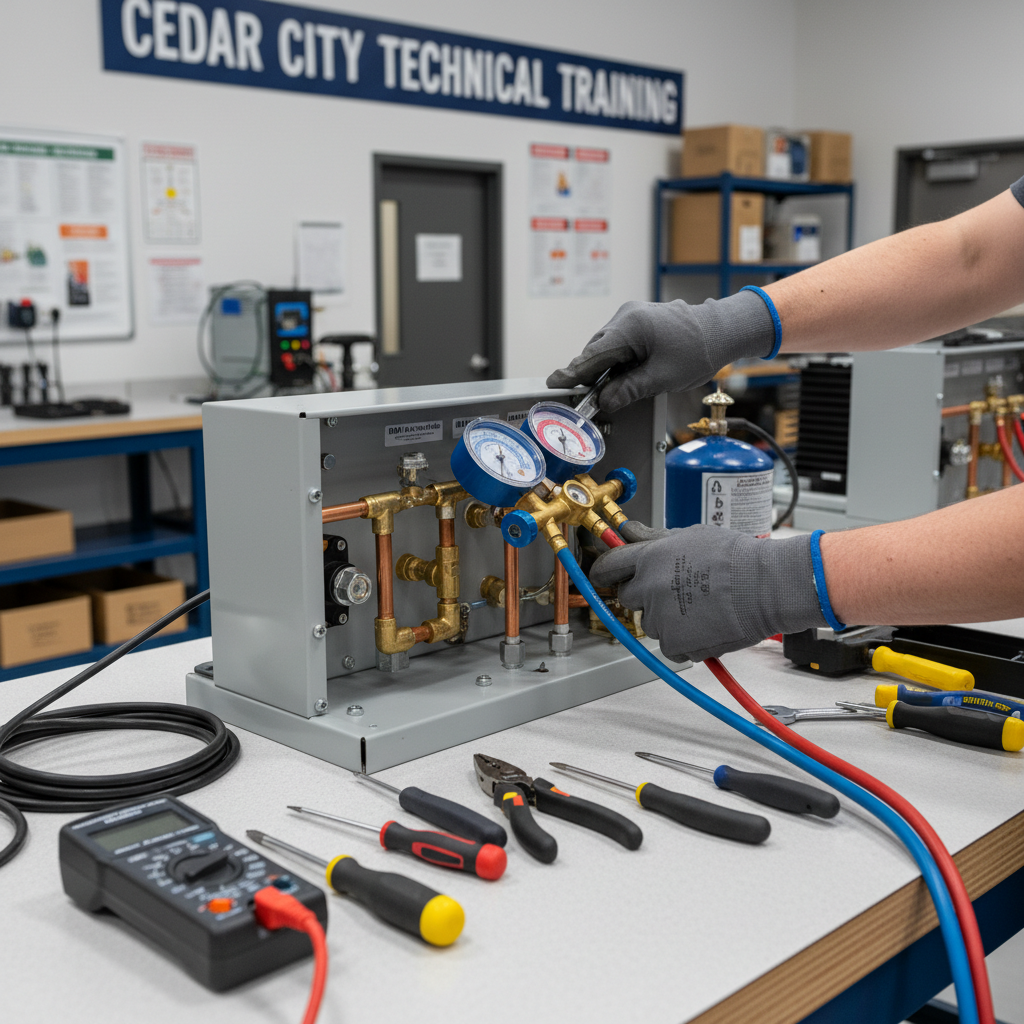
In 2026, the demand for skilled trades in the Beehive State has never been higher, particularly for those researching how to become hvac technician utah practitioners. Unlike many corporate roles currently threatened by automation, HVAC is fundamentally AI-proof. While digital tools can assist with scheduling or basic diagnostics, a software program cannot physically replace a blown capacitor, braze copper lines, or navigate a cramped attic in the middle of a Cedar City summer. This reliance on physical skill ensures that these roles remain recession-proof; climate control is a necessity for health and safety, not a luxury.
Southern Utah is experiencing a significant surge in residential development. From St. George to Cedar City, the rapid expansion of housing necessitates a constant influx of qualified technicians to install and maintain complex systems. Our region’s extreme climate, characterized by freezing winters and triple-digit summer temperatures, makes HVAC reliability a top priority for every homeowner. These environmental factors ensure that the workload remains steady throughout the year, providing a level of job security rarely found in other sectors.
The industry currently faces a critical talent shortage as a large cohort of veteran tradespeople reaches retirement age. This creates a vacuum that new, well-trained professionals must fill. By choosing career-focused education and certification programs, residents can position themselves at the forefront of this essential industry. Investing in these skills leads to long-term success and employability, offering a stable path forward as Utah continues to grow. The combination of a retiring workforce and steady new construction means that a motivated individual entering the field today enters a market that is desperate for their expertise.
Step 1: Choose Your Educational Path in Utah
Building a career in the trades requires a strategic approach to your initial training. While the state of Utah requires 8,000 hours of on the job experience to eventually sit for a contractor exam, your first hurdle is acquiring the foundational knowledge to land that initial apprentice role. For those researching how to become hvac technician utah professionals, three primary educational avenues exist within the state.
Path | Duration | Primary Focus | Best For |
|---|---|---|---|
Technical Certificate | 15–52 Weeks | Core Trade Skills | Rapid entry into the workforce |
Associate Degree | 2 Years | Trade + General Ed | Long-term academic goals |
Registered Apprenticeship | 4–5 Years | On-the-Job + Theory | Earn-while-you-learn students |
For most working adults in Cedar City, the technical certificate is the most efficient choice. Local institutions like Southwest Tech offer structured curricula that prioritize hands-on labs over general education requirements. These programs often provide evening classes, which allow you to maintain your current income while preparing for a transition. The primary advantage here is speed; completing a certificate in under a year gets you into the field faster, where you can begin accruing the 8,000 hours of experience mandated by the Utah Division of Professional Licensing (DOPL).
An Associate Degree, offered by schools like Mountainland Technical College or various community colleges, provides a broader educational base. However, for a student focused on immediate long-term success and employability, the two-year commitment can be a significant barrier. While a degree is valuable, it delays your ability to start earning a full technician's wage in the field.
Registered apprenticeships are a third option, often facilitated through the Utah Career Center. These require a commitment to 1,800 hours of annual work combined with classroom instruction. While the tuition is low, the five-year timeline is substantial. If you prefer a faster pace, focus on career-focused education and certification programs that emphasize modern digital tools and efficiency. Choosing a path that balances speed with rigor ensures you enter the workforce ready to handle the specific climate demands of Southern Utah. For personalized guidance on these options, you can contact our career advancement specialists to map out your timeline.
Step 2: Secure Your EPA Section 608 Certification
Once you have identified your training path, you must prioritize obtaining your Environmental Protection Agency (EPA) Section 608 Certification. This is a federal mandate under the Clean Air Act, meaning it is required regardless of which state you work in. Obtaining this federal credential is a non-negotiable milestone in your journey of how to become hvac technician utah professionals, as it legally permits you to handle and purchase refrigerants.
Certification Type | Scope of Work |
|---|---|
Type I | Servicing small appliances containing five pounds or less of refrigerant. |
Type II | Servicing or disposing of high-pressure appliances. This covers most residential split systems and heat pumps common in Cedar City. |
Type III | Servicing or disposing of low-pressure appliances, such as large industrial chillers. |
Universal | Covers all three types, allowing a technician to service any equipment regardless of pressure or size. |
While a Type I allows for limited work, most Utah employers require a Type II or Universal certification before they will even consider an apprentice for field work. Being able to handle high-pressure refrigerants is essential for the residential growth we are seeing in Southern Utah. The exam typically costs between $25 and $150, depending on the proctor and your choice of study materials. Investing in career-focused education and certification programs often includes preparation for this exam, ensuring you possess the long-term success and employability needed to stand out. Mastering these standards is a critical step before you move on to formal state registration.
Step 3: Register as an HVAC Apprentice with DOPL

After securing your EPA 608 card, your next objective is to formalize your status with the Utah Division of Professional Licensing (DOPL). You cannot legally perform HVAC work in Utah without a registration or license. For newcomers, this means registering as an apprentice. This step is critical because it officially starts the clock on the 8,000 hours of on the job experience required for future licensure. Understanding these legal hurdles is a key part of learning how to become hvac technician utah professionals.
There is a significant distinction between an individual registration and a contractor license. The S350 HVAC Contractor license is what allows a person to own a business or pull permits; it requires at least four years of documented experience and passing both a Trade and a Business and Law exam. However, a new technician starts with an individual apprentice registration. This registration ensures you are working legally under a licensed contractor while you build the necessary skills to eventually advance your career.
Filing your application with DOPL involves a fee, which is significantly lower for individual apprentices than the $210 required for contractors. You should account for a processing timeline of 4 to 12 weeks. Submitting your application as soon as you begin your career-focused education and certification programs prevents delays in your start date. If you have questions about navigating the Utah state portal, you can contact our career advancement specialists for assistance. Following these administrative steps ensures you remain compliant as you pursue long-term success and employability in the Southern Utah trade market.
HVAC Technician Salary in Utah: What to Expect in 2026
Financial viability is a primary motivator when researching how to become hvac technician utah residents. In 2026, the average annual salary for a technician in the state holds steady around $50,000, though this figure varies significantly based on your level of licensure and specific location. Entry level apprentices typically start between $18 and $22 per hour. This initial rate reflects the immediate value of career-focused education and certification programs that allow you to contribute to a team on day one.
As you progress toward journeyman status and complete your required hours, your earning potential increases substantially.
Experience Level | Estimated Annual Salary | Hourly Range |
|---|---|---|
First-Year Apprentice | $37,000 – $45,000 | $18 – $22 |
Journeyman Technician | $55,000 – $75,000 | $26 – $36 |
Licensed Contractor | $85,000 – $120,000+ | N/A (Business Owner) |
Salary figures often skew higher in the Salt Lake City market due to a higher density of commercial contracts. However, technicians in Southern Utah and Cedar City often find that their earnings go further; a slightly lower nominal wage is frequently offset by the lower cost of living and reduced commuting costs in our region. Furthermore, specialized expertise carries a premium. Technicians who pursue North American Technician Excellence (NATE) certifications frequently earn 10 to 20 percent more than their uncertified peers. Achieving these milestones is central to building long-term success and employability. If you want to discuss specific local pay scales, contact our career advancement specialists for a detailed breakdown of the current Iron County market.
Navigating Training Costs and WIOA Grants in Utah

While the earning potential is high, the initial hurdle for many is the upfront cost of tuition. Training for those learning how to become hvac technician utah professionals typically ranges from $3,000 to $15,000, a significant investment for any household. However, the Workforce Innovation and Opportunity Act (WIOA) offers a substantial financial bridge for eligible residents, particularly those who are currently underemployed or seeking a career change. This federal program can cover most, if not all, of your tuition for career-focused education and certification programs.
To access these grants, you must apply through the Utah Department of Workforce Services (DWS). If you are located in Iron County, visit the Utah DWS Employment Center in Cedar City to begin your application. The approval process generally requires two to eight weeks, so it is vital to coordinate your grant application with your intended program start date. Securing this funding ensures that you can focus on long-term success and employability without the distraction of new student debt. If you need assistance determining which credentials qualify for state funding or help navigating the local DWS requirements, you can contact our career advancement specialists for a step by step walkthrough of the process.
Balancing Career Transition with a Current Job
Making the leap into a new trade requires a tactical approach to your schedule. Most working adults cannot afford to quit their current jobs to return to school full time. The "earn while you learn" apprenticeship model is specifically designed for this reality. Once you secure an apprentice registration, your 8,000 hours of on the job training occur during the workday; this provides a steady paycheck while you master the craft. This path allows you to replace a stagnant income with a scalable career without a gap in your earnings.
Alvin Training streamlines this transition by replacing traditional, long term academic commitments with career-focused education and certification programs. By integrating structured curricula with modern digital tools and responsible AI, students can accelerate their grasp of technical diagnostics and regulatory requirements. This high-efficiency approach reduces the time spent in a classroom and focuses on the high impact skills required for long-term success and employability. Instead of a four-year degree, you focus on the specific credentials that get you into the field immediately.
Successful career changers often begin by attending evening sessions or using hybrid learning models to complete their EPA 608 and initial theory work. If you are navigating the logistics of a career shift in Cedar City, contact our career advancement specialists to build a training schedule that fits your current life. Learning how to become hvac technician utah professionals is about maximizing your time today to ensure a more stable financial future tomorrow.
Breaking into the HVAC industry in Utah is a rewarding path for working adults, yet it requires careful planning around certifications and local licensing requirements. While the roadmap involves several distinct steps, you do not have to navigate this transition on your own. If you want expert help to streamline your training and launch your career with confidence, you can learn more about our mission and how we support students. We are here to help you succeed in this growing field.