
The skilled trades labor shortage 2026 creates high demand for electricians, plumbers, and HVAC technicians in Southern Utah as a significant portion of the workforce reaches retirement. Aspiring tradespeople can leverage local certification courses and new training grants to secure stable careers that currently offer average annual salaries of approximately $62,000.
Southern Utah is facing a silent crisis that threatens to stall our region's unprecedented growth. While project backlogs grow and local contractors scramble for reliable help, the gap between available work and qualified labor continues to widen toward a breaking point in 2026. This shortage is not just a scheduling nuisance; it is a fundamental shift in the economic landscape of the 435 area code. Businesses and aspiring professionals must recognize that the traditional path of four-year degrees is no longer the only route to high income. In this guide, we examine why our local market has become the epicenter of trade demand. We will analyze the top careers for the coming year, address the reality of AI integration, and explore how new professionals can transition into entrepreneurship without the burden of student debt. You will gain a practical roadmap for navigating this labor shift with precision.
The 2026 Skilled Trades Labor Shortage: A Perfect Storm for Southern Utah

The skilled trades labor shortage 2026 is no longer a distant projection; it is a present reality defined by a massive demographic shift known as the Silver Tsunami. As the baby boomer generation reaches retirement age, they are exiting the workforce in record numbers, leaving behind a significant vacuum in essential infrastructure roles. Nationally, the Department of Education estimates that 2.1 million skilled trades jobs could remain unfilled by 2030, creating potential economic losses of up to $1 trillion annually. While these figures are staggering on a macro level, the impact is uniquely amplified in the high growth corridors of Southern Utah.
In Iron and Washington Counties, the demand for labor is driven by more than just retirements. The rapid expansion of residential housing and the influx of massive data center projects have created a localized pressure cooker. While contractors and developers view this shortage as a crisis that threatens project timelines, for individuals entering the workforce, it represents a rare gold mine of opportunity. The scarcity of qualified talent has shifted the leverage toward the worker.
Those who pursue career-focused education programs today are entering a market where their skills are at a premium. Unlike previous decades where entry level roles were often saturated, the current landscape allows new professionals to command higher starting wages and faster career progression. By obtaining certified professional credentials, learners can position themselves at the intersection of traditional craftsmanship and modern infrastructure needs. If you are looking to pivot into these high demand fields, you can contact our training experts to discuss the specific pathways available in Cedar City and the surrounding 435 area code.
Why Southern Utah is the Epicenter of Trade Demand
The regional demand in the 435 area code is fueled by a unique convergence of private investment and rapid urban expansion. Recently, the Lowe’s Foundation awarded a collective $8 million in Gable Grants to select technical colleges, including Dixie Technical College in St. George. This funding is specifically designed to accelerate training for HVAC, electrical, and plumbing roles; it signals a massive regional push to address the skilled trades labor shortage 2026. As Cedar City and St. George continue to rank among the fastest growing areas in the country, the pressure on local infrastructure is immense.
While Utah’s median trade salary sits at approximately $62,000, this figure represents a baseline for entry level work. The true earning potential lies in specialization and modern efficiency. At Alvin Training, we focus on career-focused education programs that bridge the gap between traditional labor and digital fluency. Those who possess certified professional credentials and can navigate AI driven diagnostics or project management software are commanding significantly higher rates than the state average. If you are ready to enter this high growth market, you can contact our training experts to map out your career path in the Iron and Washington County corridor.
Top Trades in Demand Across the 435 Area Code for 2026
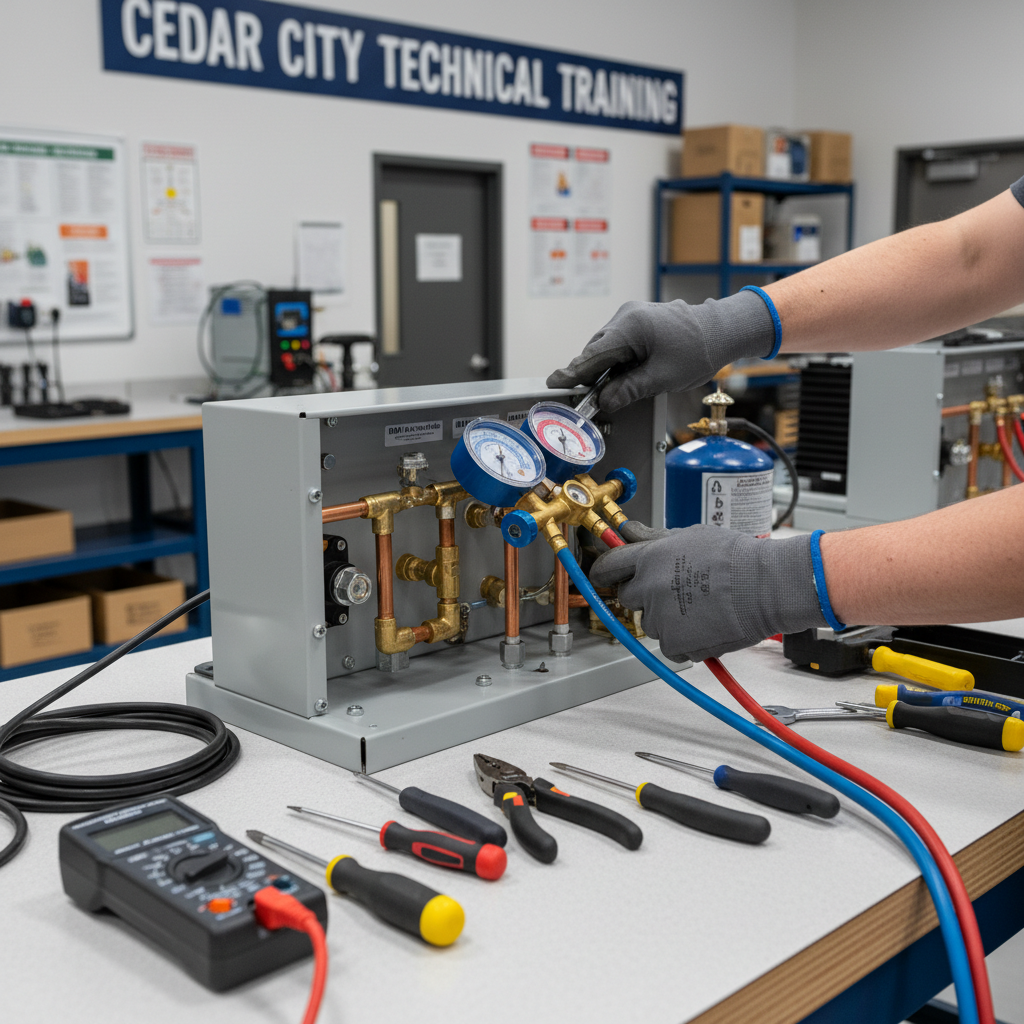
Identifying where the skilled trades labor shortage 2026 hits hardest allows prospective learners to choose high-value career paths with the greatest longevity. In Southern Utah, the demand is concentrated in sectors that are undergoing rapid technological shifts, moving away from manual labor toward highly technical, digitally integrated roles.
High-Demand Trade Sectors in Southern Utah
Trade Sector | Primary Growth Drivers | Key Digital Skills Required |
|---|---|---|
Electrical | EV infrastructure, smart home tech, renewable grid integration | Software configuration, circuit diagnostics, IoT setup |
HVACR | High-efficiency systems, climate volatility, air quality tech | Predictive maintenance software, digital airflow sensors |
Plumbing | Water conservation systems, smart leak detection, high-density residential | Digital blueprints (BIM), smart valve integration, precision modeling |
The electrical trade has evolved significantly. Iron County's expansion requires specialists who can install complex EV charging networks and manage smart-home ecosystems. This role is no longer just about pulling wire; it involves configuring sophisticated control systems and integrating renewable energy sources into the local grid. Similarly, in the high-desert climate of Cedar City and St. George, HVACR systems are now advanced environmental controllers. The 2026 market demands technicians who understand high-efficiency heat pumps and digital thermostats that leverage predictive analytics.
Modern building codes and the push for water conservation in Utah have also transformed plumbing and construction. Current projects utilize building information modeling (BIM) to ensure precision before a single pipe is laid. These pathways demonstrate that trade careers have moved past the hammer and nail stereotype. Today’s professional needs a high degree of digital competency to remain competitive. By earning certified professional credentials, you prove to employers that you can navigate both the physical and digital demands of the job site. If you are unsure which specialty aligns with your goals, you can contact our training experts to evaluate the local job market data for these specific sectors through our career-focused education programs.
Will AI Replace Skilled Trades in 2026?

A common concern regarding the skilled trades labor shortage 2026 is whether artificial intelligence will render these roles obsolete. The reality is quite the opposite. While generative AI disrupts data heavy white collar professions, it acts as a force multiplier for the physical trades. A language model cannot navigate a tight crawlspace to retro-fit a smart HVAC system or troubleshoot a faulty circuit in a Cedar City data center. Instead, AI is becoming a vital tool for the "New-Collar" professional.
Alvin Training integrates responsible AI into its career-focused education programs to prepare students for this shift. This involves using AI driven diagnostics to identify mechanical failures before they occur and leveraging automated project management tools to streamline workflows. Graduates who hold certified professional credentials are increasingly characterized by their ability to balance traditional manual skills with digital proficiency. This hybrid approach allows a technician to hold a wrench in one hand and a tablet for real-time diagnostic analysis in the other. By focusing on these efficiencies, our students become more adaptable and productive than those relying solely on legacy methods. If you want to see how these technologies are integrated into our curriculum, you can contact our training experts for a detailed breakdown of our current course modules.
The Gen Z and Millennial Shift: Entrepreneurship in the Trades
A profound shift is occurring among Gen Z and Millennial workers who increasingly view the trades as a viable path to self-employment. Recent industry data indicates that 42% of young tradespeople now aspire to own their own business rather than remain employees. In the context of the skilled trades labor shortage 2026, Southern Utah offers a uniquely hospitable environment for these micro-businesses. Unlike tech startups that require significant venture capital, specialty contracting has a remarkably low barrier to entry. A professional with a reliable vehicle, the right tools, and specialized knowledge can establish a profitable operation in Cedar City with minimal overhead.
Success in this entrepreneurial landscape begins with foundational expertise. Earning certified professional credentials provides the legal and technical baseline necessary to bid on projects and secure municipal permits. By enrolling in career-focused education programs, aspiring owners acquire the modern skills, such as digital estimating and AI integrated diagnostics, that set a new business apart from legacy competitors. Those who are ready to transition from employee to owner can contact our training experts to discuss the certification pathways that lead directly to business ownership in the 435 area code.
How to Get Into the Trades With No Experience in Utah

Breaking into the industry during the skilled trades labor shortage 2026 requires a strategic approach rather than just showing up at a job site. The first step involves identifying your specific track: blue-collar craftsmanship like welding and electrical work, or white-collar professional support roles in project management and estimation. Both pathways are currently understaffed in Iron County, but they require different foundational training.
Once a path is chosen, securing certified professional credentials is essential for rapid entry. In Utah, employers increasingly look for candidates who have moved beyond legacy training. Modern career-focused education programs provide a significant advantage by teaching students how to use digital diagnostics and project management software alongside traditional hand tools. This dual competency makes a new entrant more productive on day one than a veteran worker who relies solely on old-school methods.
Following certification, leverage the Southern Utah network. Engage with local contractors in Cedar City or attend industry meetups in St. George to bridge the gap between training and employment. If you are looking for guidance on which local certifications carry the most weight in the current market, contact our training experts to review your options. This roadmap ensures you enter the field as a high-value asset, prepared for the technological demands of the 2026 workforce.
The Financial Reality: Debt vs. Income Potential
The financial trajectory for those entering the 435 area code workforce often involves choosing between significant debt or high-ROI skill acquisition. A traditional four-year degree in Utah typically results in substantial student loans and at least four years of deferred income. Conversely, career-focused education programs lasting 6 to 12 months allow learners to enter the field rapidly. Given the skilled trades labor shortage 2026, the $62,000 median salary in Utah serves as a baseline for those with modern technical skills.
Pathway | Average Duration | Utah Median Starting Point | Student Debt Potential |
|---|---|---|---|
Traditional 4-Year Degree | 48+ Months | Variable | High |
Trade Certification | 6-12 Months | $62,000 | Low to None |
By securing certified professional credentials, you can often utilize "earn while you learn" apprenticeship models, effectively eliminating the debt burden. This creates a rapid return on investment that traditional university paths rarely match. If you are ready to evaluate the specific costs and potential earnings for your chosen field, you can contact our training experts for a direct comparison based on current Southern Utah market rates.